
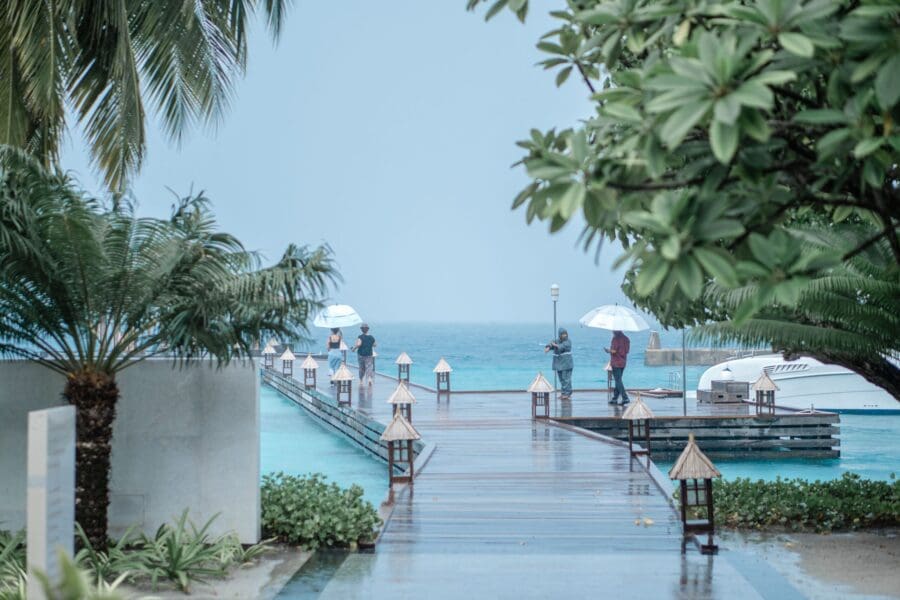
Rain doesn’t have to mean empty pools, idle staff, and bored guests. Discover how SABA Hospitality’s Digital Compendium, Mobile Ordering, and Activity Booking Platform turn rainy days into revenue and better guest experiences.
The Forecast That Changes Everything
It is 7 AM at a coastal resort. The forecast is unambiguous: rain from 10 AM through the afternoon. The pool deck will be empty. The beach club will be closed. The outdoor activities program will be cancelled.
Within an hour, the manager faces a cascade of operational problems that no amount of planning fully anticipates.
Staff. Twelve team members are rostered to the pool deck, beach club, and outdoor activities. By mid-morning, there is nothing for them to do. Send them home and lose the labour hours – and risk being short-staffed if the sun returns. Keep them on and invent busywork. Neither option is good, and both cost money.

Guests. Hundreds of guests are now confined to their rooms or the lobby. They are bored, they are disappointed, and they are looking for something to do. The printed compendium in their room lists the pool, the beach, and the outdoor activities program – all of which are unavailable. The front desk phone starts ringing with the same question: “What is there to do today?”
Revenue. The F&B outlets that depend on poolside and beach traffic lose their primary channel. The spa has availability but no way to promote it quickly. The indoor activities – the cooking class, the wine tasting, the kids’ club – could absorb demand, but nobody knows they exist, and booking them requires a walk to a reception desk that is now overwhelmed.
This is the Rainy Day Dilemma. It is not a weather problem. It is an information problem, a booking problem, and a staffing problem – all arriving at once.
And it is solvable.
“Rain doesn’t have to mean a lost day. The resorts that handle bad weather well are the ones that treat it as an operational scenario to be planned for, not a surprise to be endured.”
SABA’s integrated platform – Digital Compendium, Mobile Ordering, and Activity Booking Platform – turns the rainy day from a crisis into an opportunity. Not by changing the weather, but by changing what the resort can do when the weather changes.
1. The Operational Reality: What Rain Actually Costs a Resort
The Staffing Problem
The staffing challenge of bad weather is well documented in resort operations. During inclement weather, managers are typically forced to reschedule staff, reduce shifts, or assign idle team members to cleaning and equipment maintenance tasks. Where weather-dependent roles exist, they are among the most common candidates for temporary reduction in hours.
The “Rain Day Protocol” is a real operational concept in hospitality: a set of pre-agreed changes activated when the weather turns, including reducing to minimum staffing levels and redirecting the remaining team to batch production or preparation rather than idle waiting.
But reducing staffing is a defensive move. It saves cost, but it does not capture revenue. The more sophisticated approach is to redirect demand rather than reduce supply – which requires the technology to make indoor channels as accessible as outdoor ones.
The Guest Experience Problem
Guests do not stop wanting things because it is raining. They stop being able to access them easily.
Research on resort rainy-day operations is clear: the properties that handle bad weather well are those that can quickly surface indoor alternatives – museums, wellness centres, indoor playgrounds – and communicate them effectively to guests. The failure mode is not a lack of amenities. It is a lack of visibility and access.
Industry guidance for resorts recommends creating a wet-season amenity menu – board games, guided indoor workshops, cocktail-making sessions – and briefing F&B teams to push rain-day specials such as warm beverages, comfort food, and afternoon tea. All of this requires the ability to update information instantly and promote it to guests in their rooms.
The Revenue Problem
When the pool deck empties, the F&B revenue that would have been generated there does not automatically relocate. It disappears – unless the resort has a channel that lets guests order from wherever they now are.
This is the core insight of the rainy day dilemma: the demand does not vanish, but the channel does.
2. The Digital Compendium: Answering the Only Question That Matters
When it rains, every guest asks the same question: “What is there to do today?”
The printed compendium cannot answer it. It was printed months ago. It lists the pool, the beach, and the outdoor activities program – all of which are now unavailable. It contains no information about the spa’s rainy-day availability, the indoor cooking class, or the complimentary wine tasting in the lobby bar.
The SABA Digital Compendium answers the question in real time.
Real-Time Editing
The compendium is editable in real time – text, links, promotions, and images can be updated instantly without developer support, making it perfect for live menus, service changes, and last-minute announcements.
When the forecast turns, a staff member can update the compendium in minutes to surface:
- Indoor activities available today (cooking class, wine tasting, kids’ club)
- Spa availability and rainy-day treatment packages
- Rain-day F&B specials (comfort food, warm beverages, afternoon tea)
- Indoor wellness facilities (gym, sauna, steam room, relaxation lounge)
- Covered bars and lounges with their current hours and offerings
- Board games, books, and streaming options available on request
No App, No Friction
The compendium is browser-based and accessible via QR code on any device – phone, tablet, or laptop – with no app download and no compatibility issues. It supports videos, maps, links, and 3D tours, and can be delivered in multiple languages for international guests.
This matters enormously on a rainy day. A guest in their room, bored and looking for options, is not going to walk to the lobby to read a printed binder. They will scan the QR code on their nightstand. The compendium must be there, and it must be current.
“Old formats just can’t keep up with guest expectations. Printed guides go out of date, PDF links get lost, and apps create unnecessary friction.”
The Staff Benefit
The compendium also reduces the load on the front desk. When guests can find answers themselves, they stop calling. Hotels using the platform have seen staffing needs drop by up to 25% while maintaining high service standards.
On a rainy day – when the front desk is already absorbing a surge of displaced guests – that reduction in call volume is not a convenience. It is a lifeline.
3. Mobile Ordering: No Staffing Headache When There Is Nothing to Do
The rainy day staffing problem is usually framed as a cost problem: what do we do with staff who have nothing to serve?
The better framing is a demand relocation problem: the guests are still hungry, still thirsty, still willing to spend. They have simply moved indoors.
SABA’s Mobile Ordering platform captures that demand wherever it relocates.
The Channel Follows the Guest
Guests scan a QR code from their room, the lobby bar, a covered terrace, or any indoor outlet. They browse a multilingual menu, customise their order, and pay by card or charge to their room. Orders route directly to the kitchen via the POS.
The pool deck does not need to be staffed. The orders are coming from somewhere else – and they are arriving in the same kitchen, on the same system, with the same delivery workflow.
“Guests appreciate the flexibility and convenience of ordering whenever and wherever they choose. Whether relaxing by the pool, enjoying their room or grabbing coffee, guests can place orders without waiting for a member of staff.”
The Staffing Headache Disappears
The manager no longer faces the impossible choice of sending staff home or inventing busywork.
Staff who were rostered to the pool deck can be redeployed to in-room dining delivery, lobby bar service, or any other outlet where orders are still coming in. The labour is not wasted – it is redirected.
This is especially valuable in destinations with volatile weather: tropical resorts with afternoon thunderstorms, Mediterranean properties with occasional rain days, coastal resorts with wind that empties the beach. The ability to shift demand rather than shift staff is worth real money.
The Revenue Evidence
The numbers support the case. Mobile ordering consistently lifts average order value by 15-30%, saves 3-5 minutes per order, and reduces frontline labour needs by up to 25%. A leading Sydney hotel saw an incredible 34% increase in order value after implementation.
On a rainy day, those numbers matter more, not less. The guests are captive. The competition for their attention is low. And the resort that makes it easy to order from the room captures spend that would otherwise disappear into a delivery app – or into nothing at all.
“If one room in ten orders a $25 meal from a delivery app instead of the hotel, that is seven orders a night, $175 of sales, $63,875 a year going past the front desk in a courier bag.”
Rainy days are when that leakage accelerates. Mobile ordering plugs it.
4. Activity Booking Platform: The Indoor Activity Without the Walk
The third piece of the puzzle is the most commonly overlooked: the guest who would happily book a spa treatment or an indoor activity, but cannot be bothered to walk to another reception desk.
On a rainy day, the resort’s indoor amenities – spa, gym, cooking classes, wine tastings, kids’ club – become the primary guest offering. But access to them is often gated by a physical journey: leave the room, find the spa reception, wait in a queue behind other displaced guests, and book in person.
For a guest who is already mildly disappointed by the weather, that friction is enough to suppress the booking entirely.
SABA’s Activity Booking Platform removes the walk.
Self-Service Booking, Any Device
Guests browse available treatments and activities, book appointments directly, and receive confirmations – all without downloading an app, and on any device. Staff review and approve bookings via a centralised dashboard.
When the rain starts, the compendium is updated to feature indoor options, and the booking flow is right there. A guest reading about the spa’s rainy-day package can book a treatment in the same session, without leaving their room.
The Spa and Wellness Opportunity
Rainy days are peak demand for spa and wellness. The platform is built for exactly this: guests browse available treatments, book appointments, and receive confirmations, while front desk staff are no longer tied up manually accepting bookings.
The spa becomes the rainy day’s revenue centre – not because it was promoted heavily, but because it was made visible and bookable at the exact moment the guest was looking for something to do.
Indoor Activities and Limited-Access Experiences
The platform also supports special promotions and events: guests can book limited-access experiences without needing to call reception, and time-sensitive offers can be promoted, managed, and tracked easily.
A rainy-day wine tasting. A cooking class with the chef. A kids’ club session for the afternoon. A guided indoor wellness workshop. Each of these is a bookable, revenue-generating activity that would otherwise go unsold because nobody knew about it and booking it was too much effort.
The Staffing Benefit
The platform reduces labour demand by removing email threads and verbal requests from the booking process, reducing coordination time and freeing staff for other tasks.
On a rainy day – when staff are displaced from outdoor roles and the front desk is under pressure – that reduction in coordination overhead is exactly what the operation needs.
5. The Integrated Rainy Day: What It Looks Like in Practice
The three modules work together. Here is the sequence.
8:00 AM. The forecast confirms rain. The duty manager updates the Digital Compendium: outdoor activities marked as cancelled, indoor alternatives promoted to the top of the page, spa rainy-day packages featured, rain-day F&B specials added.
9:00 AM. Guests scanning the compendium from their rooms see a curated list of what is available today. No front desk call required. No walk to reception.
10:00 AM. The pool deck staff are redeployed to in-room dining delivery and lobby bar service. Mobile ordering is live across all indoor outlets and rooms. Orders start arriving.
11:00 AM. A guest books a spa treatment through the Activity Booking Platform. Another books a cooking class for the afternoon. A family books the kids’ club. All from their phone, in their room.
12:00 PM. The kitchen is busy. The spa is full. The lobby bar is serving. The pool deck is empty – but the revenue has not disappeared.
4:00 PM. The sun returns. Staff are still on shift. The pool deck reopens without a scramble. The compendium is updated again.
The rainy day did not produce the revenue of a sunny day. But it produced more revenue than a rainy day usually does – and it produced a far better guest experience than the alternative.
Data-Driven Takeaways for Resort Operators
If your resort still treats rain as an operational write-off, you are:
- Sending staff home or inventing busywork instead of redirecting them to where demand has moved
- Leaving guests bored and uninformed because the compendium cannot be updated in real time
- Losing F&B revenue because the poolside ordering channel disappears when the pool deck empties
- Missing spa and indoor activity bookings because guests cannot be bothered to walk to a reception desk
- Absorbing a front desk call surge that self-service information and booking would have prevented
The solution is not more weatherproof infrastructure or a bigger indoor facility. It is an integrated digital layer that lets the resort relocate demand, surface alternatives, and keep revenue flowing when the weather changes.
Conclusion: The Weather Is Not the Problem
Rain is not a crisis. A resort that cannot respond to rain is.
The Rainy Day Dilemma is an information problem, a booking problem, and a staffing problem – and each of those problems has a digital solution. The Digital Compendium answers “what is there to do?” in real time. Mobile Ordering keeps F&B revenue flowing when the pool deck empties. The Activity Booking Platform converts bored guests into spa bookings and indoor activity participants without requiring a walk to reception.
Together, they turn the rainy day from a lost day into a managed day – one where the guest experience holds up, the team stays productive, and the revenue does not vanish with the sunshine.
Stop writing off rainy days. Start planning for them.
Ready to turn bad weather into a better guest experience?
Schedule a demo of SABA Hospitality’s integrated platform today.
Discover how our solution can:
- Update guest information instantly with a real-time Digital Compendium
- Keep F&B revenue flowing with Mobile Ordering from any indoor location
- Capture spa and indoor activity bookings without a walk to reception
- Redeploy staff to where demand has moved instead of sending them home
- Reduce front desk call volume when guests can find answers themselves
👉 Request your demo now – or email our team at saba@sabahospitality.com
Read more here: https://sabahospitality.com/news/ or on eHotelier: https://insights.ehotelier.com/supplier/saba-hospitality/


