 What draws guests to a hotel for leisure is often attributed to a stay occasion, reason to visit or a peak experience – the pinnacle moment with numerous other mini-experiences on either end that fit together like a symphony. But that’s not why guests refer a hotel to friends or decide to come back again.
Here is where gastronomy becomes the pivotal experience that endears guests to a hotel. What the full definition of this word posits is that it’s precisely these meal mini-experiences – especially those involving full culinary journeys – that help to cement the memory of a peak experience in the mind so that it leaves on the highly positive impression on the guest that garners the most word of mouth and loyalty.
This brings us to the hotel in title – Sumaq Machu Picchu Hotel – a property with 62 rooms and suites, and member of Small Luxury Hotels of the World’s Considerate Collection, at the foot of the titular world wonder. The hotel offers a quintessential example of this memory-solidification principle via exceptional culinary as well as why taking gastronomy (and its nouveau extension, neurogastronomy) into serious consideration are so critical for experiential design.
Travel Context for Machu Picchu

Machu Picchu is a single site that most people will visit once. They come in, they leave, and then what’s left is a photo or two on Instagram. What makes this worse is that getting into the mountainous region of Machu Picchu Town is an arduous journey of three hours each way from Cusco. That means loss of sleep, which any wellness professional would tell you translates into reduced memory solidification.
Sumaq presents a luxury alternative to this commute – staying in Machu Picchu Town so that you can leisurely wake up to make your ticketed entry time to the archaeological site. It’s a no-stress way to circumvent the six-hour commute in and out the mountains back to Cusco where most people stay.
Importantly, though, that six-hour logistical mess of trains, buses and hikes means less time to reflect and reminisce. The memory fades faster because you’re spending all your energy and attention getting to and from the world wonder rather than actually soaking it in.
Enter Neurogastronomy
And while you still “see” Machu Picchu, the senses of taste and smell can take up far more neuronal activity in the mind. In this way, food pervades everything and is the connective tissue by which travel memories are codified into rich, long-lasting narratives in our mind. The peak experience is there, but it’s enriched and given the breadth of space in the brain by sharing a great food before and after.
Neurogastronomy is the optimal word nowadays to describe the complex interacts between food ingredients, food preparation, food presentation, texture, time of day and personal upbringing. This is a field advanced by Yale neuroscientist Gordon Shepherd, proposing that flavor is not just a property of the food itself but a construction of the mind, assembled from aroma, texture, temperature, sound, memory and expectation. It carries cultural, biological, neurological and physical components at once.
This means a restaurant that thinks carefully about setting, story and sequence is not only decorating a meal but how the dining experience will be remembered as categorized next to the peak experience of visiting a once-in-a-lifetime archaeological site. So, with Sumaq, it’s a matter of having the culinary presentation embrace its surroundings and advance the local narrative so that the visit to Machu Picchu is more vividly remembered.
The Table as Memory Device
Qunuq, Sumaq’s restaurant, offers a tasting menu called Flavors of the Andes: Apucc Mikhuna, with this Quechua phrase translating roughly to ‘the food that the mountains give us’. In our case (Adam’s), this grand dinner occasion was served in a private setting, with flower petals laid and candles across the floor to guide the way in. From the perspective of neurogastronomy, before a single course arrived, the mind had already been cued that this would be worth encoding.
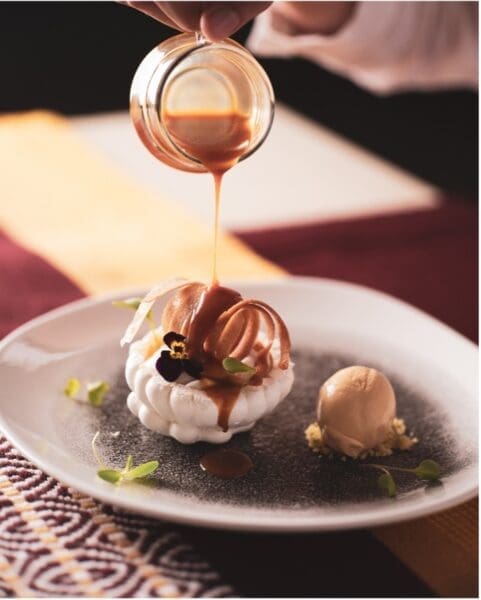
To dive into some specifics for color (literally and metaphorically!), the menu opened with a mild cream of choclo, the large-kernel corn of the Urubamba Valley and a snow of Andean cheese, then a quinoa tabbouleh dish to quietly demonstrate how naturally Andean staples sit inside a Mediterranean template. The course that best illustrates neurogastronomy in practice was the hot stone ceviche – cubes of fresh trout arrive on a heated local stone then drizzled with leche de tigre, sizzling and steaming as each dropped touched the hot surface. So, here you have sight, sound, smell and sense of place all preceding taste.
We could go on, especially the piscos or the multi-course meal’s denouement with an edible Inca bracelet. The bottom line here is that every element of the evening carries forward the narrative of where we were on the globe and also the solidification of the total Machu Picchu experience – as opposed to what most tourists end up doing which would be more akin to a dine and dash of the world wonder.
 Cultural Custodians
None of this culinary prowess works without sourcing and knowledge servers to tell the story tableside. As we learned from conversations with the restaurant team and Sumaq’s co-owner, Angie Clavijo, the kitchen buys directly from highland farming communities, including native potatoes from Huatata where more than 350 varieties are cultivated.
This practice – for potatoes as well as varietals of quinoa, cacao, corn and many others – supports agrobiodiversity, meaning the cultivation of crops that never enter international commodity trade and therefore quietly disappear when globalization arrives. Zapallo loche is a good example as a squash domesticated in pre-Columbian Peru and now protected by its own denomination of origin.
Every time zapallo loche now appears on a menu at this level, its commercial future strengthens. In this sense, bastions of hospitality like Sumaq that support local farmers and educate their teams on how to discuss all these hyper-local ingredients are akin to cultural custodians rather than only hoteliers.
Ultimately, the guest gets a remarkable meal; the farmer gets a reliable buyer; a landrace fruit or vegetable survives another generation; and the traveller goes home carrying a memory of Machu Picchu that is far, far richer than an Instagram post.
If you remember what implied by neurogastronomy, then you will carry with you the fact that everything is set and setting. A fond memory of an activity or place that was consolidated over a table, in conversation with friends and staff, and within an incredible atmosphere is how the moments around the moments help to maximize guest satisfaction. From there, that satisfaction is what translates into return visits, recommendations and all the other elements that create an incredible hotel over time.