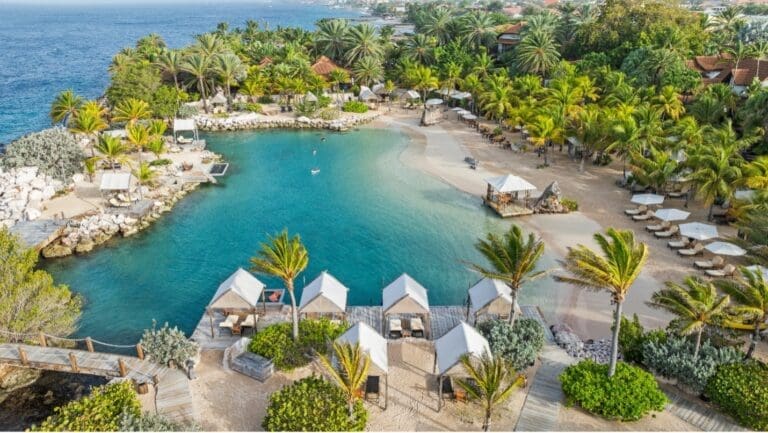
Now firmly in the back half of the 2020s, one megatrend that we’re all aware of is how the experience economy has caused a mushrooming of luxury hospitality. There are now innumerable brands in this space, so much so that to wrap our heads around it we’re niching luxury into traditional, experiential, uber, ultra, wellness and other modifiers.
We both find this to be exhilarating. There are new property openings and announcements every week, each one marked by incredible design, bold F&B and wellness offerings that push what’s possible in a hotel environment. While it’s a bit hard to fully encapsulate in one article, we’ll do our best with a top ten listicle!
- Low Occupancy By Design
It’s about exclusivity in experience and privacy within an immaculate space. If a hotel is too crowded or full, service has a hard time being wholly anticipatory and ‘any way you want it’ — a common example being the ability to book an elaborate spa ritual last minute at a peak time of day.
- Key Count Scarcity
Echoing the push for throttled occupancy to maintain a Veblen goods quality, the schism between luxury and ultraluxury is marked by rarity in the number of rooms, suites and cottages — with many exceptions, typically below 75 keys. Too large and you lose the intimate community feel. And hand in hand with a low key count is the absence of a flag or being part of a collection with a limited number of properties.

- Multigenerational Travel
While some places cater to adults, others are designing amenities or reconfiguring rooms to appeal to families and relatives traveling as a pack. Think kids clubs, private chef dinners in a villa or suite conversions. With boomers at the helm for the next decade, they want to spend their nest egg on travel rather than leave an inheritance
- Barefoot Beyond Beaches
Not a new trend by any means but a timeless one as old as the first resorts. While most would conjure images of ‘barefoot’ denoting a tropical beach or jungle escape, the traction of grounding, earthing and forest bathing will be the idea of reconnecting with the land spread across the globe.
- Agriluxury (also known as Farm Hospitality)
Speaking of reconnecting with the earth, there’s big money in creating a rural bastion of hospitality where guests can learn about agriculture, practice culinary techniques and enjoy delicious, nutritious food. Accompanying this are a smattering of vineyards, onsite herbalism, equestrian programs, apiary experiences, fermentation courses, education on regeneration or anything else pre-modern era.
- Sustainability As Brand DNA
Luxury and sustainability are now wholly intertwined. Guests demand it, not just as virtue signaling or ‘being seen going green’ but as a way to be immersed in the story of healing the planet through thoughtful design, upcycled organic materials, low-food-mile meals and clean air. It’s not about checklists but actual regeneration.
- Cultural Stewardship
Intermixed with sustainability is the notion of preserving a locality’s arts, architecture, crafts, dance, languages, music and culinary styles by being monetary patrons or stewards. This not only provides guests with exclusive experiences but also wins over the community who participate in the gains, rather the hotel being extractive.
- Wellness As Status
The notion of ‘health is wealth’ is perhaps most commonly understood amongst the wellness-primary traveler. It’s still on the rise for wellness-secondary travelers. But this status is more than just being in shape; it’s about community wellness and socialization with likeminded souls as made accessible via wellness resorts and luxury hotels with a strong wellness footprint.
9. Integrated Wellness Stay
Wellness has moved far beyond traditional spa services. This we already know. What’s on the upswing are curated, personalized, multi-day itineraries that bring together a myriad of wellness modalities that act synergistically to improve one’s health. Think 3, 4, 7, 14 or 21-night retreats with diagnostics, personal training, physiotherapy, psychotherapy, spa, sleep amenities, thermal, photobiomodulation and a bespoke meal plan.
10. Cognitive Longevity
The tenth one is on a somber note: the increasing lifespans that certain countries are experiencing also means an increase in the number of people who are at risk of dementia as a form of ‘end-stage disease’. Hotels are already pivoting by being centers for people to undergo advanced treatments, neurofeedback and metabolic therapies that sharpen the mind, staving off any decline. Besides the clinical angle, hotels can serve as places of reflection and restoring dignity to afflicted individuals. So much more on this, but what parts in luxury will inevitably move down the chain-scale via economies of scale.
Bonus: The Everything Somm
(Can’t end on doom and gloom now can I?) Ultraluxury has moved beyond the standard concierge desk and virtual complement. A wine sommelier at a restaurant? Why not have a cicerone (beer sommelier) or a tea sommelier who can also practice herbalism? Better yet, incorporate the somm into the prearrival journey so that guests’ beverages can be tailored from the moment they arrive. Contemporary luxury wellness requires a similar degree of bespoke intake. All of it is experiential. And it’s only achievable at a boutique scale.